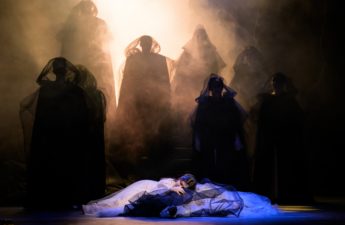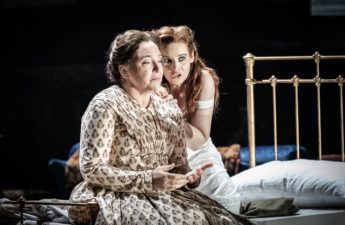
‘…It seems beyond dispute that Parsifal, both in terms of its concept and in its finished form, requires no interpretative artifices on the part of performers or scholars to justify it, let alone enhance its significance in the modern era’ , wrote Arnold Whittall just over a decade ago in The Wagner Style. Close Readings and Critical Perspectives (albeit qualifying his remarks with certain reservations). The fact that not everyone is convinced of the relevance of Richard Wagner’s final drama in its own right is evidenced by numerous productions in the Regieoper tradition (such as Jay Scheib’s 2013 production in Bayreuth, which required the audience to wear glasses enabling them to experience augmented reality). Concert or semi-staged performances, however, provide arguments in support of Whittall’s thesis. The recent production by the Mahler Players in Inverness (27 May 2026) strikes me as a strong argument in favour of the musicologist’s view.
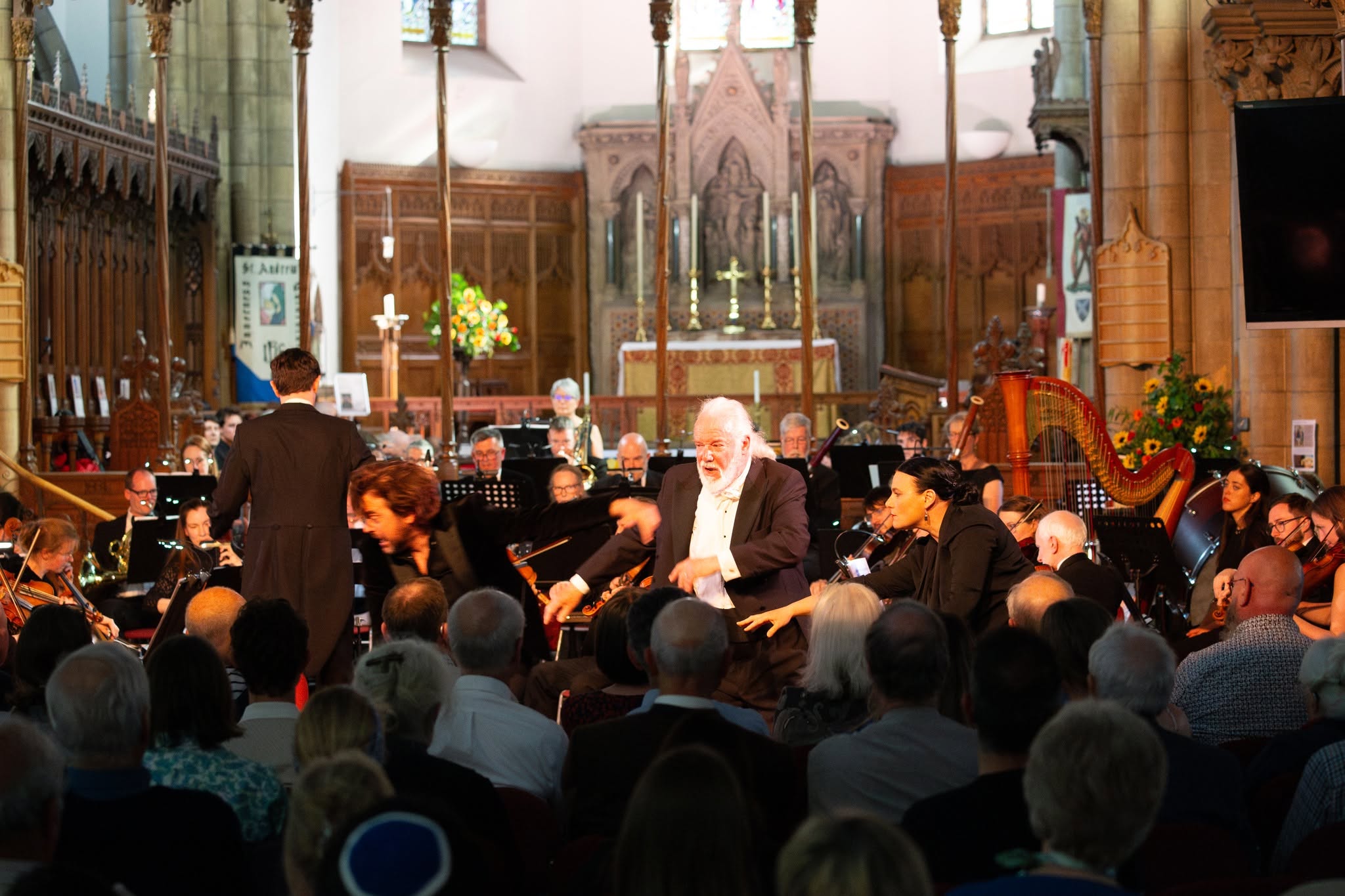
It must be admitted, however, that the Scottish Parsifal required a bit of a trick. The ensemble founded by Tomas Leakey performs Wagner with a smaller line-up than that specified in the scores (some of the conductor’s previous projects have been reviewed by Dorota Kozińska, for example here). They performed Parsifal in Matthew King’s reorchestration – one that quite magically reduces the ensemble without losing any of the tone, variety or grandeur (as in the ever-magnificent Verwandlungsmusik, for instance), and above all, without compromising the role that orchestration plays in building atmosphere, space, narrative and revealing the characters’ psychological states. Such a convincing result of Matthew King’s work must have stemmed precisely from a deep understanding of the orchestra’s essential role in musical drama.
The Mahler Players did not quite manage to handle every detail of the score, nor did they always demonstrate precision in intonation or articulation, but there were captivating moments in their fully committed performance – in the Vorspiel they displayed a soothing, rounded tone; the music accompanying Gurnemanz’s tale of the creatures dwelling in the sacred forest shimmered and came alive, as it did during the Grail ceremony. Impurities and other technical issues did not prevent the ensemble from maintaining a compelling narrative. In Act II, the orchestra provided excellent support for the singers, contributing significantly to the development of a slow emotional crescendo. Tomas Leakey conducted his ensemble with clarity and the utmost concentration, attentively registering and responding to every move by the soloists.
This was aided by the reduced cast, as well as the acoustics of St Andrew’s Cathedral. I couldn’t help feeling that if, a few years ago at the Polish Music Festival in St Catherine’s Church, the decision had been made to perform Karol Szymanowski’s Hagith not in its original form, in a new chamber version (there would certainly have been a composer or conductor who would have relished the challenge of preparing such a version), it might have been possible to avoid certain problems with the balance between the voices, the orchestra and the choir. That said, a group of singers such as the one Tomas Leakey invited to perform would have coped under any circumstances.
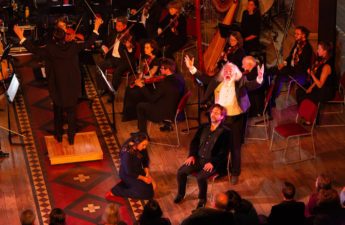
The cast was, in fact, excellent. Not only were the soloists’ skills, but also their emploi, perfectly suited to the characters. Although they performed in concert attire, with only slight variations depending on the character or situation (Parsifal in a co-ordinated outfit, whilst Gurnemanz and Amfortas wore tailcoats; Kundry in Act II wore red earrings and red lipstick; the Flower Maidens wore colourful dresses), the performers fully embodied their roles. I went to Inverness primarily to hear John Tomlinson, a bass whom I particularly admire for the title role in Harrison Birtwistle’s The Minotaur, written especially for him, though he is probably better known to a wider audience for his roles in Wagner’s operas, Mozart’s Sarastro or Mussorgsky’s Boris Godunov. Tomlinson’s Gurnemanz was utterly convincing as the eldest of the knights – powerful (the soloist, not quite eighty, still possesses a magnificent voice) and dignified, displaying maturity, wisdom and a profound sense of responsibility as he looked after the Order of the Grail at a difficult time. He exuded authority and credibility. He delivered his monologue in Act I in such a way – shaping the phrasing, dynamics, timing and pauses so skilfully, and conveying the text so clearly – that I listened to him with bated breath, as if I were hearing the story of Amfortas’ ill-fated quest against Klingsor for the very first time. Every line was imbued with the appropriate emotions – Gurnemanz was one way when defending Kundry, another when facing the clueless Parsifal, and yet another – resigned – at the start of Act III. Even moments of visible and audible exertion, as well as the occasional tightness in his voice, were skilfully woven by Tomlinson into the character’s portrayal. It was a deeply moving moment when Gurnemanz led Amfortas, who was leaning on him (played by Thomas Weinhappel, superb as a ruler wounded physically, but above all psychologically) – younger, taller and, were it not for his wound, stronger – from the crossing of the naves, past the orchestra (where most of the action took place), behind the orchestra to the chancel, which had become the Temple of the Grail. Notable performances included Sion Goronwy’s Titurel – whose warm voice inspired trust – Renatus Mészár’s Klingsor, a villain teetering on the edge of caricature, and, in a minor role as one of the knights, Petro Wychrij – who came across as unsympathetic in his cold, almost shrill outbursts directed at Kundry.
Julian Hubbard portrayed the title character not only as naïve, but also as comical, even clownish. The Parsifal of Act I looked at Gurnemanz, who was explaining the rules of the sacred forest to him, as if Gurnemanz were the fool, and sang his parts decidedly in the buffo style. In Act II, this style of expression was somewhat less suited to the situation, yet Hubbard persisted with it for quite some time, delaying the first signs of his transformation until the very last moment. The slightest breaks in his voice during the monologue ‘Amfortas! Die Wunde!’ were, however, already fully deliberate and dramatic. The star of this act, however, was undoubtedly Kundry. Almerija Delic, possessing a mezzo-soprano voice of immense power across all registers, great richness and impeccable control, portrayed a woman who was tormented and trapped, yet constantly striving to break free. Delic perfectly captured the mixture of strength and helplessness. Through her body language, she emphasised the character’s animalistic nature – at times dangerous and predatory, at others hounded and longing only for eternal sleep. At times seductive, at times intrusive, at times withdrawn. In the story of Herzeleide, she performed through both her singing and her silence, making the pause before the final word ‘starb’ in the monologue almost palpable, and imbuing that very last word with the darkest of dark hues.
Both the soloists and the orchestra, under Leakey’s baton, built up such intense tension in Act II that, as soon as it ended, a loud sigh could be heard from the audience – which I am not at all surprised by.
It is therefore to the credit of Tomas Leakey and the Mahler Players not only that this is the first performance of the complete Parsifal in Scotland in almost a quarter of a century, but above all that they have performed it so brilliantly. My only regret was that I couldn’t stay in the capital of the Highlands any longer to participate in a panel discussion on organising musical life outside the major centres, scheduled for the following day. Especially as Leakey not only discusses this topic, but – through his work with the Mahler Players on projects such as Parsifal in Inverness – proves that it can be done and that it’s worth it.
Translated by Aleksander Ptak